Businesses considering Odoo ERP often begin with one important question:
How much does Odoo ERP implementation cost in Qatar?
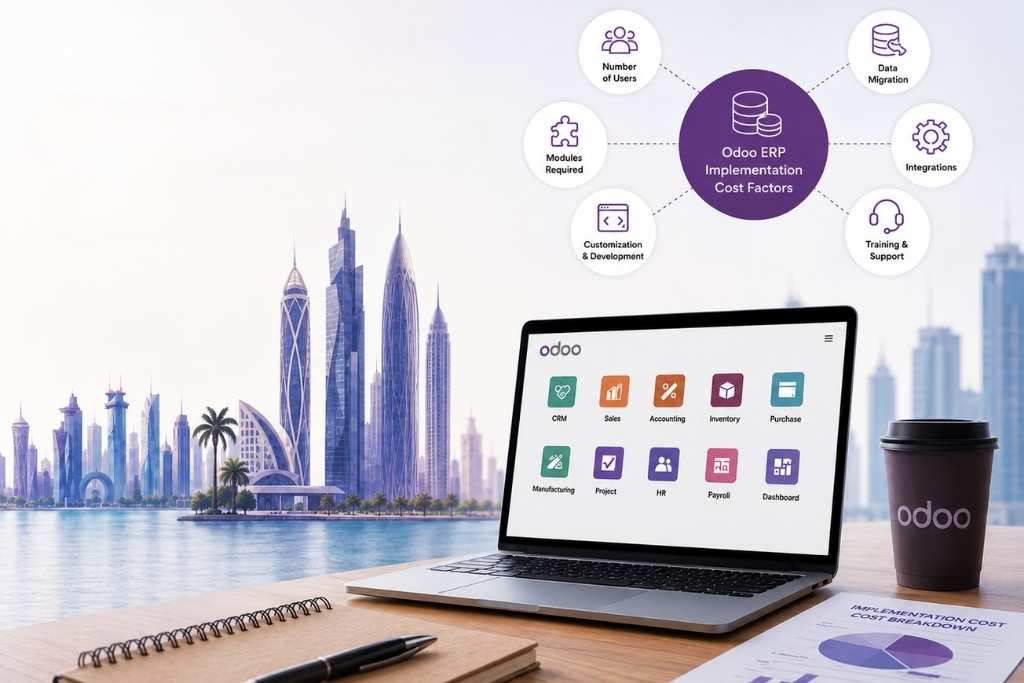
There is no single fixed price that applies to every business. The total investment depends on the size of your company, the number of users, the modules required, the complexity of your workflows, the amount of customization, data migration, training and ongoing support.
A small company implementing a few standard modules will usually require a smaller investment than a multi-company organization with several branches, complex approvals, integrations and customized reports.
This guide explains the main factors that determine the cost of an Odoo ERP implementation so you can plan your project more accurately.
What Is Included in the Cost of Odoo ERP?
The overall cost of an Odoo ERP project generally consists of two main components:
- Odoo software subscription and hosting
- ERP implementation and related professional services
The software subscription gives your users access to the selected Odoo plan and applications. Implementation services cover the work required to configure the system around your business processes and prepare your team to use it.
Depending on the project, the implementation may include:
- Business requirement analysis
- Odoo configuration
- Module setup
- Workflow customization
- Data migration
- Third-party integrations
- User-access configuration
- Testing
- Employee training
- Go-live assistance
- Post-implementation support
Understanding these components is important because the software subscription alone does not complete the ERP implementation.
1. Number of Odoo Users
The number of internal users is one of the main factors affecting the software subscription cost.
An Odoo user is usually an employee who needs backend access to perform activities such as:
- Creating quotations and sales orders
- Processing purchases
- Managing inventory
- Recording accounts and invoices
- Managing employees
- Updating projects
- Approving transactions
- Viewing operational reports
A company with five users will have a different subscription requirement from a business with fifty users.
Before requesting a quotation, identify which employees genuinely require access. Not every employee may need full backend access. Proper user planning can help control costs while maintaining appropriate access to information.
2. Odoo Subscription Plan
The selected Odoo edition and plan also influence the cost.
Your choice may depend on factors such as:
- Whether standard Odoo features are sufficient
- Whether custom modules are required
- Whether Odoo Studio will be used
- Whether external systems need to be integrated
- Whether the system requires cloud or on-premise hosting
- Whether the company manages multiple businesses
The correct plan should be selected based on technical and operational requirements—not only on the lowest subscription price.
A professional requirement analysis can help determine which plan is suitable before any license is purchased.
3. Number of Modules Required
Odoo includes applications covering a wide range of business functions. However, the implementation effort increases when more modules and departments are involved.
Frequently implemented modules include:
- CRM
- Sales
- Purchase
- Inventory
- Accounting
- Point of Sale
- Human Resources
- Payroll
- Attendance
- Time Off
- Manufacturing
- Project Management
- Field Service
- Helpdesk
- Website
- E-commerce
A basic implementation covering CRM, Sales and Invoicing will normally require less work than a complete implementation involving Sales, Purchase, Inventory, Accounting, HR, Manufacturing and multiple branches.
The cost is not determined only by the number of modules. It also depends on how deeply each module must be configured.
For example, an Inventory implementation with one warehouse and standard stock movements will be simpler than an implementation involving multiple warehouses, batch tracking, serial numbers, landed costs, barcode operations and custom approval processes.
4. Business Process Complexity
Two companies using the same Odoo modules may have very different implementation costs.
Consider two trading businesses. The first may follow a simple process:
Quotation → Sales Order → Delivery → Invoice
The second may require:
Lead Qualification → Multi-Level Approval → Sales Order → Credit Check → Procurement → Partial Delivery → Multiple Invoices → Payment Allocation
Although both companies use CRM, Sales, Purchase, Inventory and Accounting, the second business has more complex workflows.
Implementation cost can increase when the company requires:
- Multi-level approvals
- Department-specific workflows
- Multiple companies or branches
- Several warehouses
- Different price lists
- Multiple currencies
- Complex access permissions
- Intercompany transactions
- Specialized reports
- Industry-specific operational processes
Documenting your current workflows before implementation helps the ERP partner estimate the project more accurately.
5. Odoo Customization
Odoo provides many standard features, but some businesses require functionality that is specific to their operations.
Customization may include:
- Custom fields and forms
- Specialized dashboards
- Approval workflows
- Customized quotations and invoices
- Industry-specific modules
- Automated notifications
- Custom reports
- Customer or supplier portals
- Unique accounting allocations
- Additional access-control rules
- Custom mobile or web interfaces
Minor changes using existing configuration tools may require limited effort. Developing a completely new module or modifying core business logic requires more technical work, testing and maintenance.
Before approving customization, ask:
- Is this requirement essential?
- Can the process be handled using a standard Odoo feature?
- Can the workflow be simplified?
- Will the customization affect future upgrades?
- Who will maintain the custom functionality?
Avoiding unnecessary customization can reduce implementation cost, shorten the timeline and simplify future upgrades.
6. Data Migration
Most businesses already have important data stored in spreadsheets, accounting software, legacy ERP systems or other applications.
The cost of migration depends on:
- The volume of data
- The quality of the existing data
- The number of source systems
- The complexity of relationships between records
- Whether historical transactions are required
- The amount of cleaning and formatting needed
Common data migrated to Odoo includes:
- Customer information
- Supplier information
- Product details
- Price lists
- Opening balances
- Inventory quantities
- Employee records
- Outstanding invoices
- Outstanding payments
- Selected transaction history
Data migration is often underestimated. Duplicate customers, incomplete product details, incorrect tax information and inconsistent spreadsheet formats can increase the time required.
Businesses can reduce migration costs by cleaning and organizing their data before the project begins.
7. Third-Party Integrations
The implementation cost may increase when Odoo must communicate with other platforms.
Possible integrations include:
- Payment gateways
- E-commerce platforms
- Banking systems
- Shipping providers
- Government platforms
- Biometric attendance machines
- WhatsApp or messaging systems
- External CRM platforms
- Business intelligence tools
- Custom mobile applications
- Existing websites
The complexity depends on whether the external platform provides a reliable API, how much data must be exchanged and whether the integration needs real-time synchronization.
Every integration should be clearly defined before development begins. This includes the data being transferred, the direction of synchronization, error handling, access security and ongoing maintenance.
8. User Training
Even a technically successful ERP implementation can fail when employees are not properly trained.
Training costs may depend on:
- Number of users
- Number of departments
- Number of modules
- User roles
- Training format
- Requirement for training documents
- Need for repeated sessions
Different employees require different levels of training.
For example:
- Sales representatives need CRM and quotation training.
- Storekeepers need inventory and delivery training.
- Accountants need invoicing, payment and reporting training.
- Managers need dashboard and approval training.
- System administrators need user-management and configuration training.
Role-based training is usually more effective than giving every employee the same general session.
9. Testing and Go-Live Support
Before the system goes live, the configured workflows must be tested using realistic business scenarios.
Testing may include:
- Sales transactions
- Purchase processes
- Inventory movements
- Invoice creation
- Payment processing
- User permissions
- Approval workflows
- Reports
- Integrations
- Data accuracy
Complex projects require more testing because a mistake in one workflow can affect other departments.
Go-live support is also important. During the first days or weeks, employees may need assistance while they become familiar with the new system.
Including testing and go-live support in the project scope can reduce operational disruption.
10. Post-Implementation Support
ERP implementation does not end on the go-live date.
After implementation, your business may require:
- User assistance
- Error resolution
- Additional reports
- Workflow improvements
- New employee training
- New modules
- Integration maintenance
- System upgrades
- Performance monitoring
- Additional customization
Support may be included for a defined period or offered through a separate monthly, annual or hourly agreement.
Before selecting an Odoo partner, confirm:
- What support is included?
- How long is the support period?
- What is the response time?
- Which requests are considered additional work?
- Who will manage future updates?
- Is local support available in Qatar?
A slightly lower implementation quotation may become more expensive later if essential support is excluded.
How Is Odoo Implementation Cost Calculated?
A reliable quotation should be based on a proper requirement analysis rather than a general package price.
The ERP partner may assess:
- Company size
- Number of users
- Number of branches
- Required modules
- Existing software
- Business workflows
- Customization requirements
- Integration requirements
- Data volume
- Training requirements
- Expected project timeline
- Support expectations
The quotation should separate major cost components wherever possible.
For example:
- Software subscription
- Implementation services
- Custom development
- Data migration
- Integration
- Training
- Support
- Hosting, when applicable
This makes the proposal easier to evaluate and reduces the risk of unexpected costs.
Basic, Moderate and Complex Implementations
Although every project is different, Odoo implementations can generally be grouped into three levels.
Basic Implementation
Suitable for a small company with:
- Limited users
- One company
- A few standard modules
- Simple workflows
- Minimal data migration
- Little or no customization
Moderate Implementation
Suitable for a growing company with:
- Multiple departments
- Several modules
- Custom reports
- Approval workflows
- Moderate data migration
- User training
- Some integrations or customization
Complex Implementation
Suitable for a larger organization with:
- Multiple companies or branches
- Many users
- Complex workflows
- Large data volumes
- Custom modules
- Multiple integrations
- Advanced reporting
- Extensive training and support
These categories can help businesses understand project complexity, but an accurate cost still requires a detailed assessment.
How to Reduce Odoo ERP Implementation Costs
Businesses can control costs without compromising implementation quality by following a few practical steps.
Start with essential modules
Implement the modules that solve your most urgent operational problems. Additional modules can be introduced in later phases.
Use standard Odoo features where possible
Adapting unnecessary internal habits to standard workflows may be more cost-effective than customizing every step.
Clean data before migration
Remove duplicate, outdated and incomplete records before sending data to the implementation team.
Appoint internal key users
Select employees who understand each department and can make timely decisions during implementation.
Confirm requirements early
Frequent changes after development begins can increase both cost and timeline.
Implement in phases
A phased approach allows the company to control risk, train users gradually and distribute the investment over time.
Focus on business value
Evaluate each requirement based on the operational problem it solves, not simply whether it would be useful to have.
Questions to Ask Before Accepting an Odoo Quotation
Before selecting an implementation partner, ask:
- Which Odoo plan and hosting option are included?
- How many users are covered?
- Which modules will be implemented?
- What configuration work is included?
- What customization is included?
- Is data migration included?
- Which integrations are included?
- How many training sessions will be provided?
- Is testing and go-live support included?
- What post-implementation support is provided?
- What items could create additional charges?
- What is the estimated implementation timeline?
The cheapest quotation is not always the most cost-effective. Compare the full scope, implementation approach, experience, support and long-term maintainability.
Get an Accurate Odoo ERP Cost Estimate in Qatar
The cost of Odoo ERP implementation in Qatar depends on your users, modules, workflows, customization, migration, integration, training and support requirements.
The best way to determine the investment is to begin with a structured requirement discussion.
Sygmetiv Business Solutions provides Odoo ERP consultation, implementation, customization, migration, training and support for businesses in Qatar. We help companies select the right modules, simplify workflows and implement a scalable ERP system based on their actual operational needs.
Contact Sygmetiv Business Solutions to schedule an Odoo ERP consultation and receive a customized implementation proposal.
An exact quotation requires an assessment of your users, modules, business workflows, data, integrations, customization and support needs.
Yes. A phased implementation is often suitable for businesses that want to prioritize essential departments, control risk and spread the investment over time.
No. Many businesses can operate using standard Odoo features. Customization should be used when there is a clear operational requirement that cannot be addressed through standard configuration.
The number of internal users can affect the Odoo subscription cost and may also increase the training and access-configuration effort.
Yes. A small business can begin with essential modules and add more functionality as the company grows.
No. The subscription covers access to the selected Odoo plan. Implementation services cover analysis, configuration, migration, customization, training, testing and support.